
Fringe Repair & Replacement
Fringe is the end of the rug’s foundation, not decoration, so when it shreds the rug is unravelling. We secure the ends, rebuild lost warps, and replace or re-knot fringe to match the original.
Torn edges, missing fringe, moth grazing, a corner the puppy decided was a chew toy, or a rug that spent a night on a wet basement floor. Most of it is fixable by hand.
Rug repair is not patching. A proper repair rebuilds the rug the way it was originally made — foundation first, then pile, matched to the original knot density and dye lot — so the repaired section moves, wears and ages at the same rate as everything around it. Done well, you have to be told where it was.
That is slow work. Reweaving is measured in square inches, not square feet, and a hand on a loom is the only tool that does it properly. The upside is that damage most people assume is terminal usually is not. Rugs arrive folded around a hole and go home flat and whole.
Every repair starts with a free assessment and a straight verdict. If the cost of the work is out of proportion to what the rug is worth, we say so instead of taking the job.
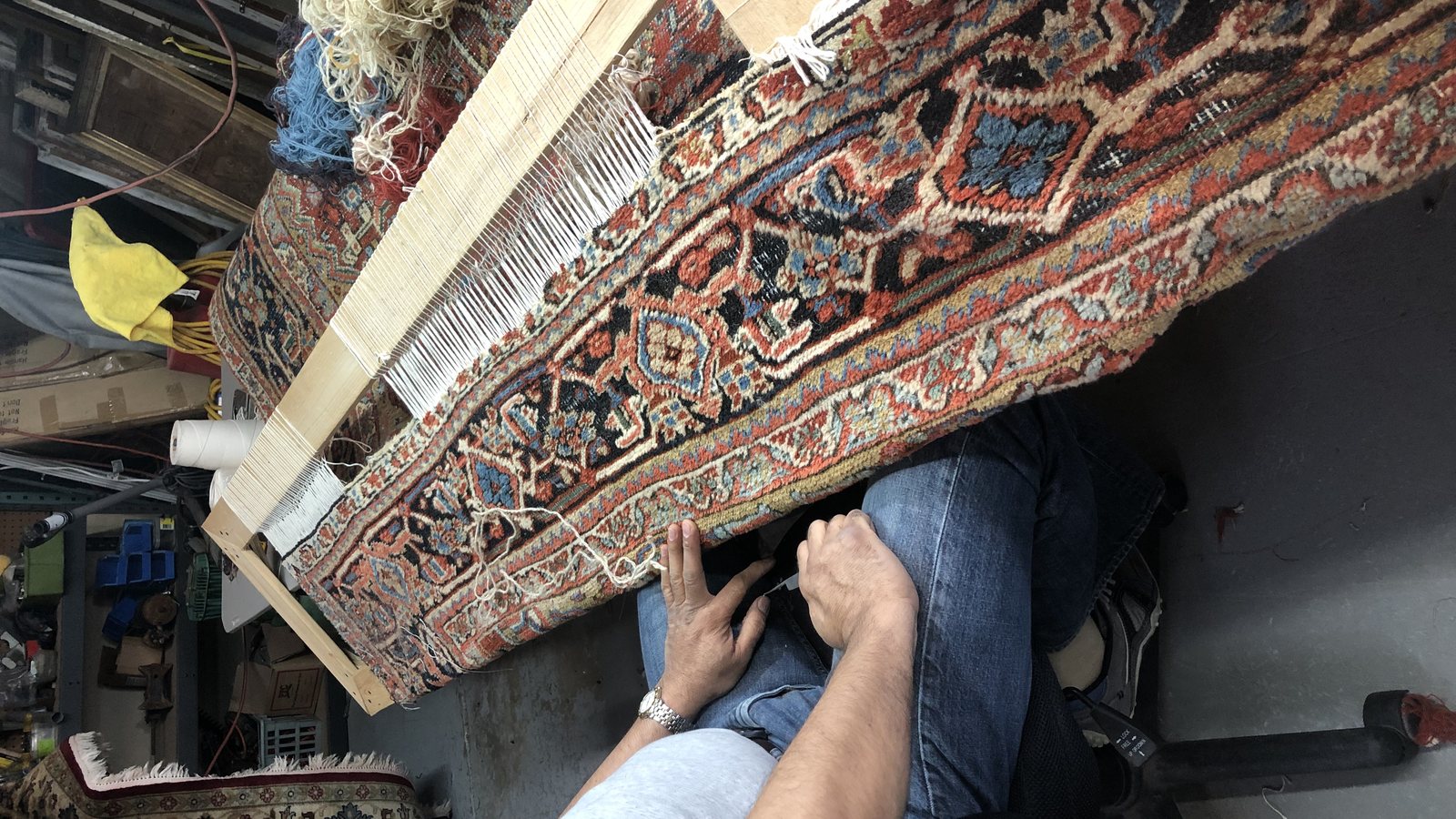
From a short fringe tidy to rebuilding a foot of missing border.
Fringe is the end of the rug’s foundation, not decoration, so when it shreds the rug is unravelling. We secure the ends, rebuild lost warps, and replace or re-knot fringe to match the original.
Side cords take the abuse from vacuum beaters and furniture legs. Once they split, the pile beside them starts letting go. Edges are rewrapped by hand in matched wool.
Burns, tears and worn-through areas are rebuilt knot by knot. The foundation goes back first, then the pile, matched in fibre, colour and density to the field around it.
Moth larvae eat wool from underneath, so by the time bare foundation shows there is usually an active problem. We treat the infestation, then reweave the grazed areas. Rugs stored over a summer in a garage or an attic are where we find it most.
Chewed corners, clawed edges and urine-burnt dye. The rug is decontaminated first, then the missing structure is rebuilt and colour corrected where the original dye was destroyed.
Sun-bleached bands from a west-facing window, bleach spots, and dye that migrated during a bad cleaning or a soaking. Colour is rebuilt by hand where the fibre is still sound.
Rugs cut down to fit a room, or blocked back to square after years of buckling. Cut edges are properly finished so the rug reads as intentional rather than amputated.
Failed latex on hand-tufted rugs, brittle cotton warps in antiques, and rugs that ripple because the foundation gave way. Structure gets fixed before anything cosmetic.
A great many of the repairs we do could have been avoided by a decent pad. We fit breathable, non-adhesive pads sized to the rug — which matters most on a basement slab, where trapped moisture is the whole problem.
A water heater that let go, a supply line behind a washing machine, a slow leak under a dishwasher, or groundwater arriving at the uphill wall of a finished lower level after a long wet week. The rug on that floor is now on a clock.
Wool survives being wet surprisingly well. What it does not survive is staying wet. In a warm room, mould establishes in a saturated foundation in roughly forty-eight hours, and once it is at the base of the pile you cannot vacuum, spray or air-dry it back out. At the same time unstable dyes start migrating, cotton foundations begin to rot, and whatever the water picked up crossing the floor — drywall dust, floor sealer, whatever was under the appliance — is curing into the rug.
A fan pointed at a wet rug is not restoration. It dries the surface, locks the contamination into the foundation, and produces a rug that smells fine for three weeks and then does not. The rug has to be flushed.
Send pictures of the damage, or we collect the rug at no charge anywhere on the Hamilton County and North Georgia route.
The damage is mapped, materials identified, and you get a written price with options. No work starts without your approval.
Repairs go onto a clean rug. Working new wool into a dirty field leaves a visible patch a year later.
Wool selected by fibre, weight and dye lot against the original, and tested against the field before it goes in.
Foundation rebuilt, then pile knotted in at matching density, then sheared to the surrounding height.
Groomed, inspected against the intake photographs, and delivered back to your floor.
Free assessment on every repair, and a real answer about whether it is worth doing.
The six-stage hand wash every rug goes through, and why in-home wand cleaning fails here.
Cleaning processHumidity, basements, red clay and hardwood — what rug owners in this valley need to know.
Care notesCollection and delivery included across Hamilton County and the North Georgia line.
Contact us